The world’s largest robot sports competition is being held in Incheon, South Korea this year. Three thousand competitors. Fifteen thousand expected visitors. Twenty-nine years of continuous competition building toward a deadline — a team of fully autonomous humanoid robots capable of defeating the human World Cup champions — that was set in 1997 and now, for the first time, looks genuinely achievable within the timeframe its founders specified.
Video Overview (9:34 Mins)
What RoboCup Is — And Why the 2050 Goal Still Matters
RoboCup was established in 1997 in Nagoya, Japan, by a group of researchers who argued that robot football provided the ideal benchmark problem for artificial intelligence and robotics. The competition needed a goal ambitious enough to require sustained multi-decade research effort — something that couldn’t be solved in a single research cycle and then shelved. The 2050 target served that purpose.
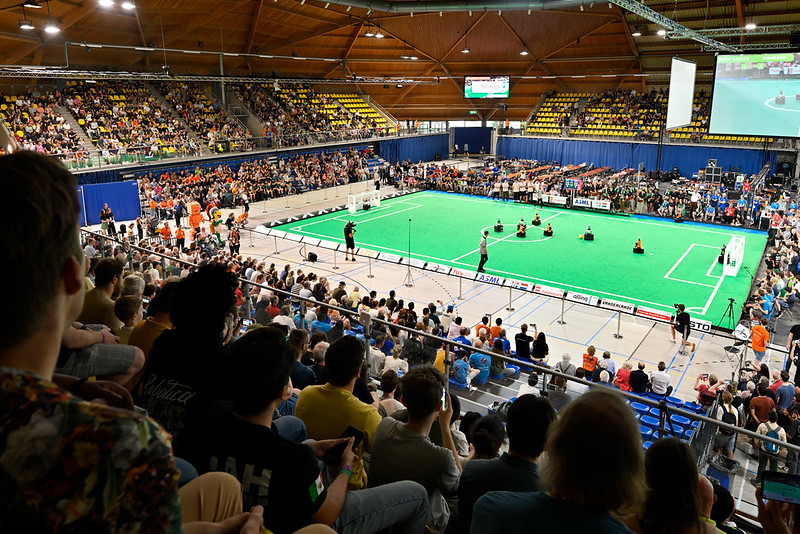
The first competition attracted 40 teams from 11 countries. The robots competing bore almost no resemblance to humanoids — most were wheeled platforms executing basic ball-tracking behaviors on miniaturized pitches. The football on display was, by any honest measure, primitive.
That is precisely the point. RoboCup was never designed to produce impressive football immediately. It was designed to produce a research community that would work continuously on the hardest problems in autonomous robotics, year after year, measuring progress against a fixed long-term target. The 2050 deadline created a framework. The annual competition created accountability.
Twenty-nine years later, RoboCup 2026 brings together more than 3,000 competitors, researchers, students and professionals from dozens of countries, as well as 15,000 visitors.
The 2050 goal, which required high hopes and optimism to state publicly in 1997, now requires a certain level of cynicism to fully dismiss as possible. A robot broke the human world record for the half-marathon in April 2026. A robot beat a world-ranked table tennis professional in competitive play. A humanoid robot learned one of football’s hardest trick shots in the computational equivalent of a single day. None of that was true at RoboCup 2025 in Salvador, Brazil. All of it is true now.
Why 2026 Is the Most Significant RoboCup in Years
For most of RoboCup’s history, the humanoid football league ran on Nao robots — small, white, 58-centimetre machines manufactured by SoftBank Robotics. They were capable platforms for academic research. As a spectacle, their football was slow, frequently interrupted by falls, and bore limited resemblance to the human game.
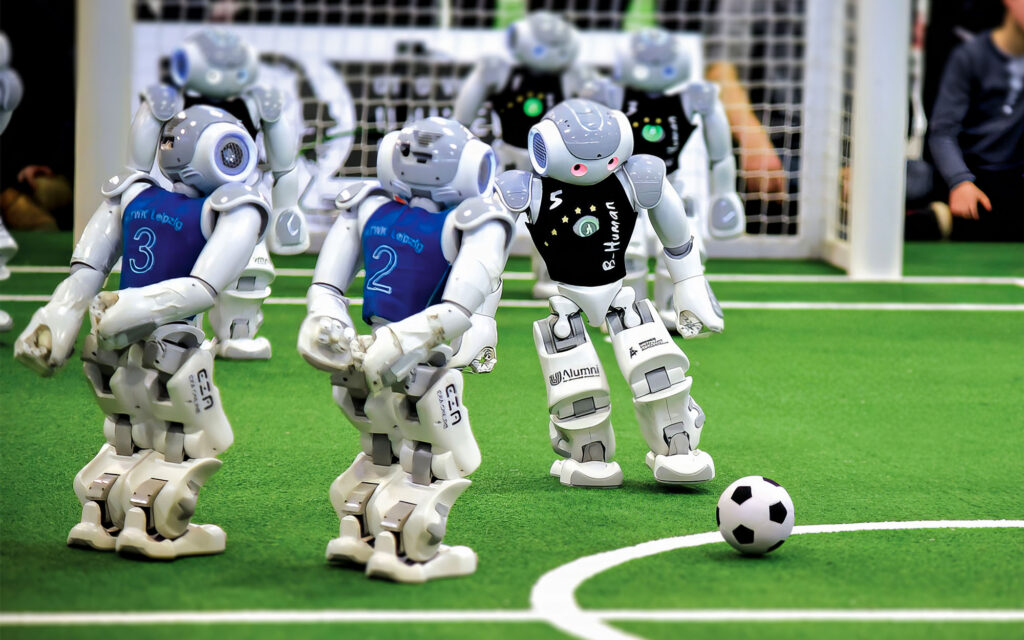
RoboCup 2026 marks the debut of the Humanoid Soccer League — a newly unified competition merging the former Humanoid League and Standard Platform League into a single framework. The reasoning was practical: both leagues were working on the same fundamental research problem from different angles. A unified structure allows for direct comparison of approaches and faster collective progress.
The more significant change is in the hardware.
The RoboCup Federation has formed partnerships with Booster Robotics, Fourier Intelligence and Unitree Robotics, aiming at the highest-quality AI and humanoid robotics research and education, fostering the participation of those companies’ humanoid robots in RoboCup competitions.
Through new agreements with these manufacturers, the programme now offers additional platform options — Booster is launching the K1 RoboCup Edition, and Unitree is introducing the R1 robot to its product lineup.
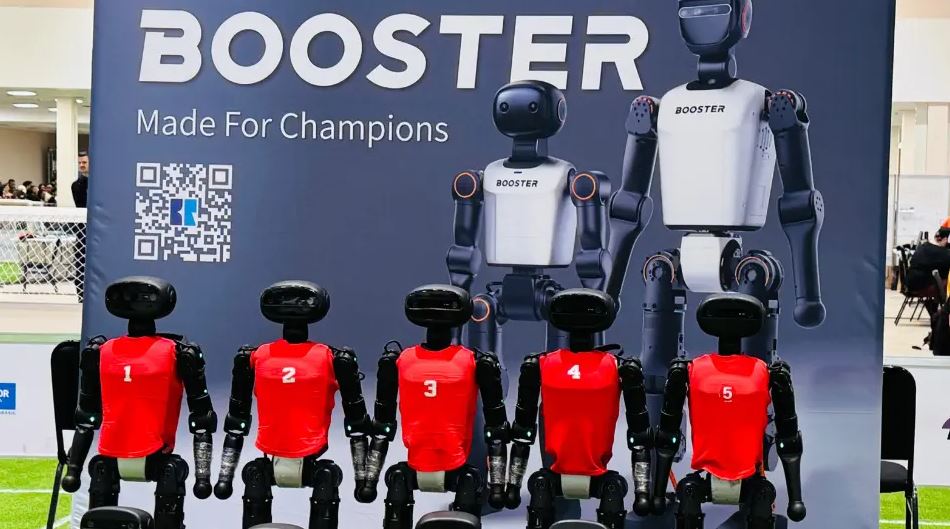
For RoboCup 2026, Booster will provide a robot pool featuring K1 and T1 humanoid robots, which teams may borrow for competition use. This matters because it removes one of the most significant barriers to entry the competition has historically faced — the cost and availability of competitive hardware. A university team without the resources to develop or purchase its own platform can now borrow Booster robots and compete on equal hardware footing with well-funded research institutions.
The full list of eligible standard robot platforms includes Nao V5 and V6, Darwin, Booster T1 and K1, Fourier GR1, GR1-Pro and GR2, and Unitree G1 and H1.
That list reads differently in 2026 than it did two years ago. The Unitree H1 is the same platform used in multiple competitive robot athletics events this year. The Booster T1 and K1 are from the same manufacturer whose T2 model faced a former Chinese national goalkeeper in a penalty shootout with eye opening results. These are not academic research machines with narrow application. They are the front line of humanoid robotics development, competing in a research context that has been running continuously for nearly three decades.
The Humanoid Soccer League — What Actually Happens on the Pitch
The Humanoid Soccer League features fully autonomous humanoid robots competing in soccer matches and technical challenges, serving as a research platform for advances in humanoid robotics including perception, locomotion, learning, behavior control and multi-robot coordination.
The autonomous element is worth emphasizing explicitly. No human operator controls these robots during a match. No joystick, no remote control, no real-time instruction. Each robot perceives its environment through its own sensors, makes its own decisions about where to move and when to kick, and communicates with teammates through programmed coordination protocols. The football is genuinely autonomous.
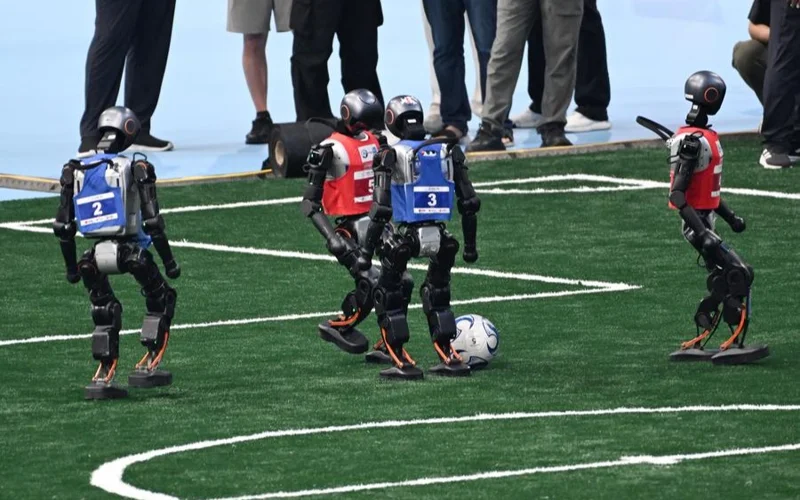
Three divisions compete, defined by robot size and weight — Small Division for robots under 110 centimeters and 15 kilograms, Middle Division for robots under 125 centimeters and 25 kilograms, and Large Division for robots under 190 centimeters and 80 kilograms.
The Large Division is the one that matters most for understanding where robot sport is heading. Robots approaching 190 centimeters tall and 80 kilograms in weight are operating at roughly human scale — the same dimensions as a professional footballer. Watching Large Division robots play football in 2026 is a materially different experience from watching Nao robots play in 2016.
Falls still happen. Decision-making in dynamic multi-robot environments remains a hard unsolved problem. The gap between a robot that can execute a skilled individual movement and a robot that can play tactically within a team against other robots is substantial. Watching RoboCup with honest expectations means accepting both the genuine progress and the genuine limitations simultaneously.
RoboCup and the Broader Robot Sports Landscape
RoboCup exists in a different relationship to the rest of robot sport than it did even five years ago.
For most of its history, RoboCup operated largely in parallel to mainstream awareness of robotics — a specialist academic competition known within the research community and largely invisible outside it. The events of 2025 and 2026 have changed that relationship. When a robot breaks a human world record in April and an autonomous robot football competition begins in June, those two facts sit in the same public conversation in a way they previously didn’t.
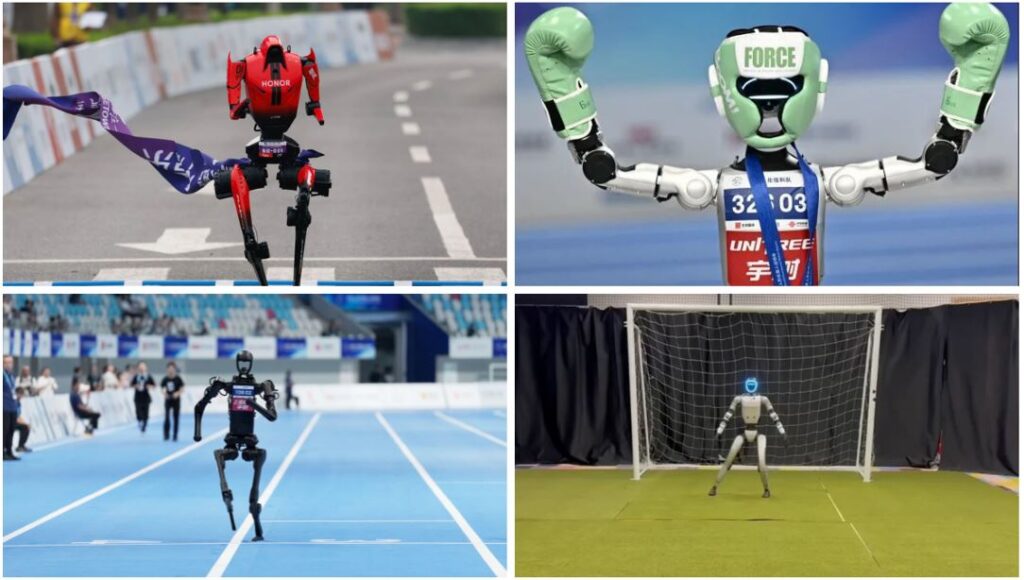
The robots competing at RoboCup 2026 are built on control systems and motion algorithms that overlap significantly with the robots generating headlines elsewhere. Booster’s presence at RoboCup 2026 is a direct connection between the academic competition that has been running since 1997 and the commercial robot sports ecosystem emerging in 2026
That convergence — academic research competition and commercial sport entertainment sharing hardware, sharing manufacturers, and increasingly sharing audiences — is one of the more significant structural developments in robot sport right now. RoboCup didn’t create robot sport entertainment. But twenty-nine years of continuous research produced the machines that are making it possible.
How to Watch RoboCup 2026
Competition streams and schedules are published through the official RoboCup channels at robocup.org and the RoboCup 2026 Incheon site. The Humanoid Soccer League Large Division is the most immediately accessible entry point for anyone new to the competition — the scale of the robots and the football format make it the most legible for a general audience.
For context on what you’re watching when you tune in — the robots are fully autonomous throughout each match. What looks like hesitation or poor positioning is the robot’s onboard systems processing perception data and calculating decisions in real time, with no human input. Every movement is generated by the robot itself.
The falls are part of the story, not a sign that something has gone wrong. Recovery from falls — how quickly, how reliably, how little game time is lost — is itself a research metric that RoboCup teams have been working on for years. Watching how robots handle failure tells you as much about the state of the technology as watching what they do when everything works.