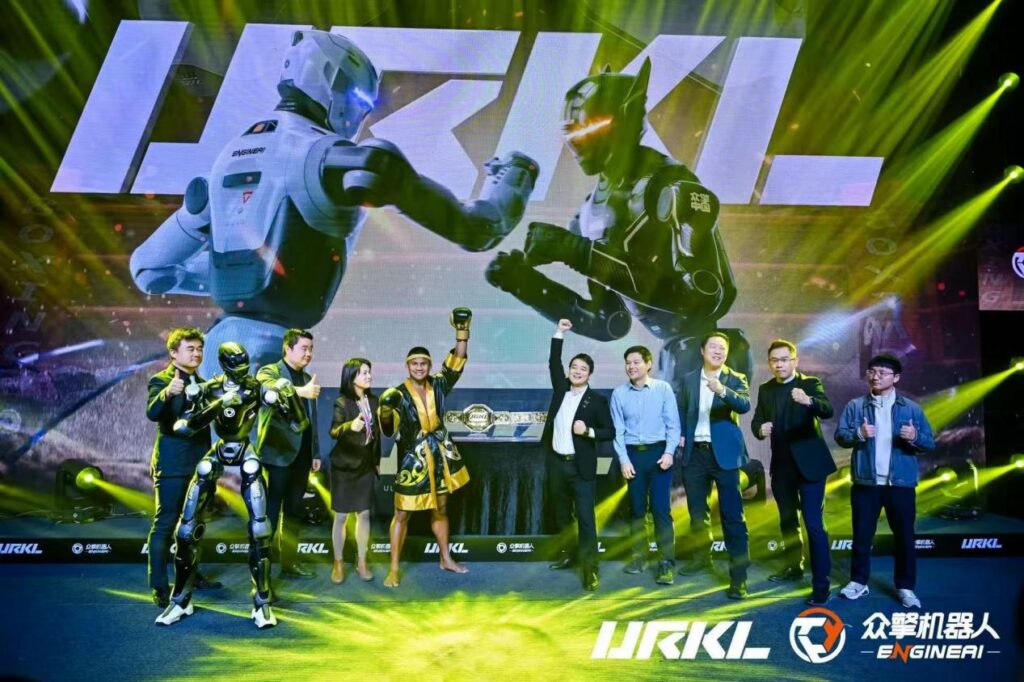
The launch event for the Ultimate Robot Knockout Legend (URKL) was held on February 9, 2026, in Shenzhen, China, to showcase the world’s first professional humanoid robot free-combat league — a full competitive season running from July through December 2026, with thirty-two teams competing across a tiered schedule for a significant prize: a ten-kilogram pure gold championship belt worth ten million Chinese yuan, approximately $1.44 million.
What Ultimate Robot Knockout Legend (URKL) Actually Is
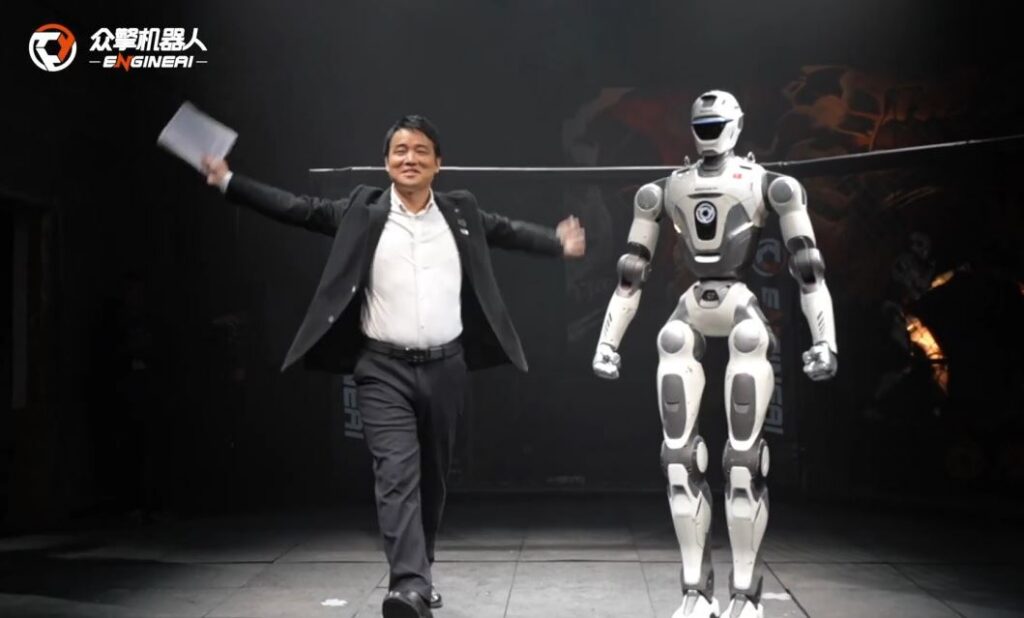
The competition was organized and launched by EngineAI, the Shenzhen-based humanoid robotics manufacturer whose T800 robot has become the signature platform of the league. Zhao Tongyang, EngineAI’s founder and CEO, framed the event as a statement about what robot combat sport has become and just how far the technology has progressed.
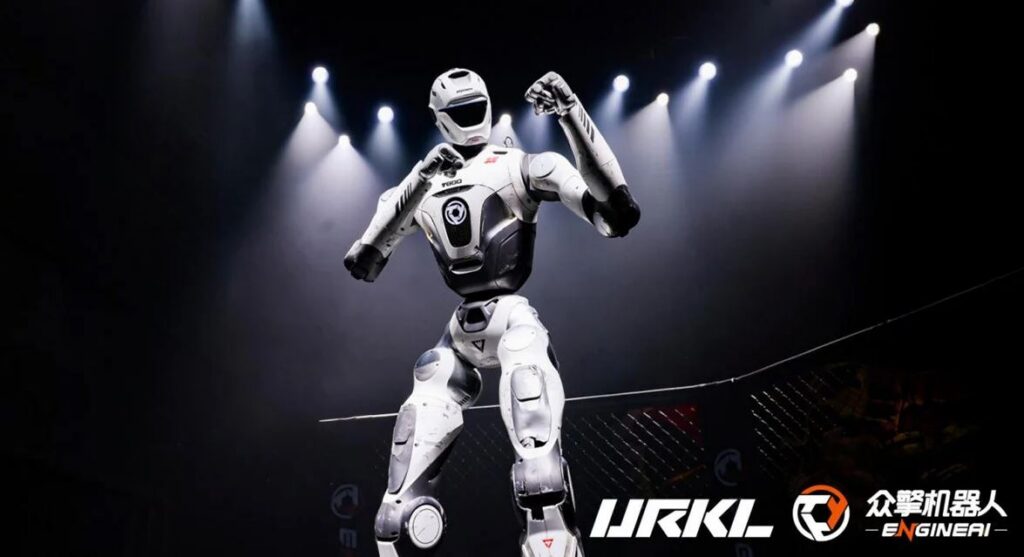
Every participating team receives T800 robots free of charge for the duration of the competition, enabling hands-on development alongside the competitive programme. This arrangement is deliberate: URKL is explicitly designed as a test bed for humanoid robotics under physical combat conditions, not just purely as entertainment. The competition is the research, and the research is the competition.
The T800 — The Robot at the Centre of Everything
The EngineAI T800 stands 1.73 metres tall — five feet eight inches — and weighs 75 kilograms. It is built with 29 high-degree-of-freedom joints on the body, a solid-state battery for extended operation, and an aluminum alloy exoskeleton designed for structural integrity under high-impact conditions. Its seven-degree-of-freedom arms — three rotations each for shoulder and wrist, plus elbow flexion — match the range of motion of a human arm exactly.
EngineAI does not position the T800 as a research prototype. It is designed and marketed as a general-purpose humanoid capable of both industrial deployment and physical performance, including martial arts movements: 360-degree aerial rotation kicks, sidekicks, combination strikes. These are not party tricks engineered separately from the robot’s core capabilities. They are expressions of the same dynamic balance and full-body coordination that make the T800 viable for demanding industrial environments.
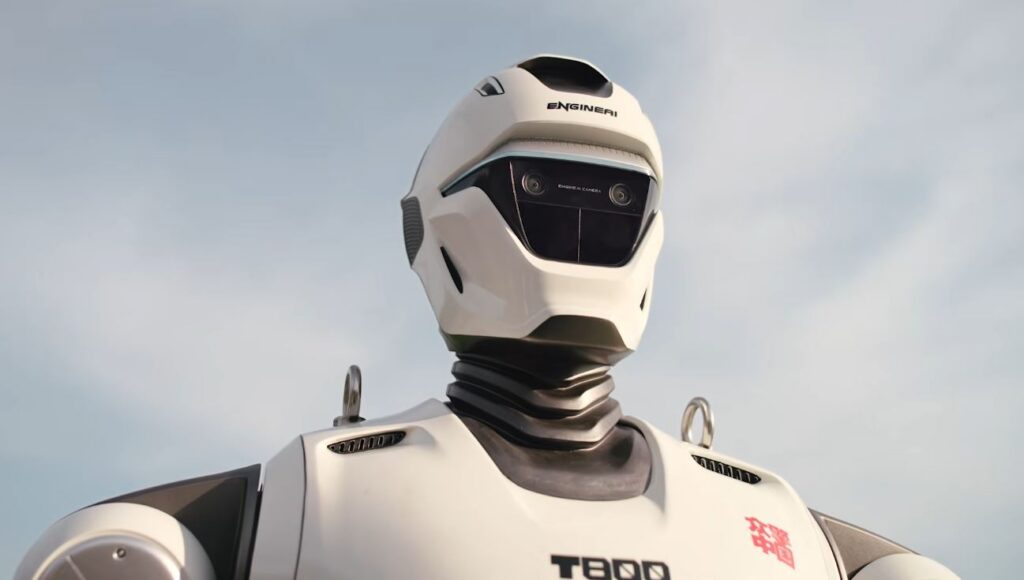
The T800 is the same robot that REK brought to San Francisco in June 2026 — the first of its kind imported to the United States and specifically imported for combat sport. It’s the same platform EngineAI built to survive a full professional fighting season in URKL, absorbing strike after strike under conditions no factory floor is likely to demand. The combat sport application and the industrial application share the same machine.
That isn’t coincidental. It’s the entire point.
What Makes URKL Different from Every Other Robot Combat Format
Three robot combat organizations are currently operating at meaningful scale in 2026. Each has taken a fundamentally different position on the most important question in the sport: how much human involvement should there be during a fight?
REK’s answer is deep embodiment — the pilot inhabits the robot through VR controls; their intent translated into robot movement through pre-trained policies. Ultimate Fighting Bots (UFB) answer is accessibility — a game controller, available to anyone, triggering AI-trained movement sequences. Ultimate Robot Knockout Legend’s answer is the most radical of the three.
URKL’s control system is a hybrid of human strategy and AI execution.
Human operators control each robot using handheld remotes and custom control interfaces, dictating overarching strategy: positioning on the mat, when to advance, when to trigger specific combat moves. The robot’s internal AI handles execution — calculating the micro-adjustments required for walking, shifting weight, and throwing strikes without losing balance. The human provides the intent. The AI provides the physical execution.
This places URKL closer to REK’s VR-piloted model than it might first appear, though the autonomy depth is different — URKL’s robots handle far more of their own physical decision-making than a directly teleoperated system would. The practical result is combat behavior that is faster and more dynamically responsive than pure teleoperation, while remaining strategically directed by a human operator rather than running entirely on pre-programmed routines.
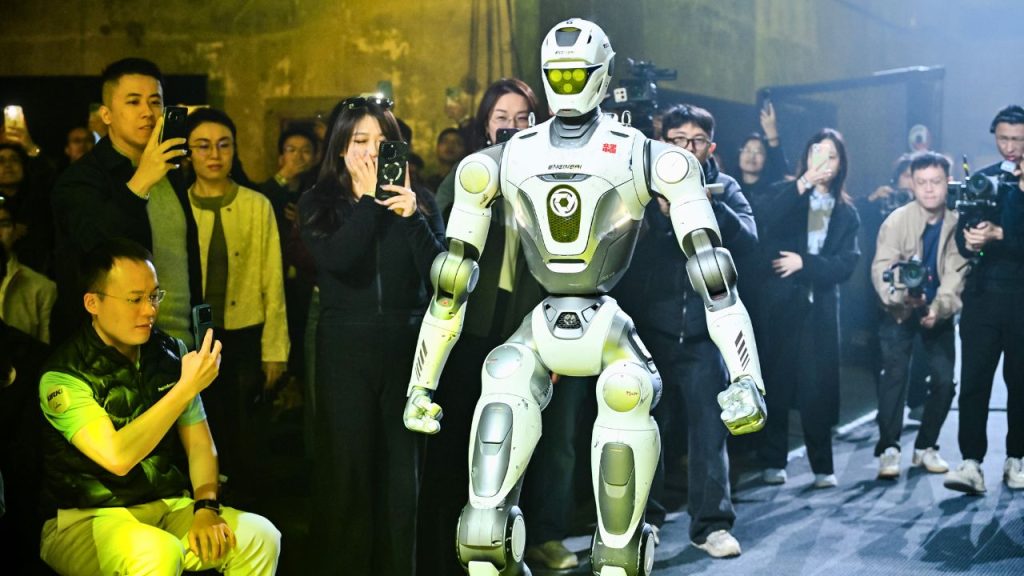
The combat this produces goes beyond what fully human-piloted robot combat can achieve. Aerial rotation kicks and sidekick combinations executed faster than any human pilot could trigger through purely VR or joystick controls. Movements that are even arguably impossible for a human fighter to even perform — not because the robot is necessarily stronger, but because the AI can commit to and execute movements without the hesitation that human motor control introduces.
Mark Setrakian — who built Robot Combat League for SyFy in 2013, the first humanoid robot combat television show — said explicitly at the time that he intended to keep his robots free of internal intelligence, because the human pilot’s soul was what made the format emotionally meaningful. URKL is slowly moving in the opposite direction. The soul of URKL is certainly the engineering team’s, but while in combat, the robot expresses a combination of pre-programmed actions triggered by what a pilot is feeling in the moment.
Whether that’s more or less emotionally compelling than 100% pilot-driven combat is one of the most genuinely interesting open questions in robot sport right now.
The CMG Connection — State Broadcaster Backing
Ultimate Robot Knockout Legend exists within a broader Chinese robot combat sport ecosystem that is developing faster, and with more institutional backing, than anything currently happening in the United States or Europe.
The China Media Group — CMG, China’s state-run national broadcaster equivalent to the BBC — ran the world’s first humanoid robot combat event in Hangzhou on May 25, 2025, broadcast nationwide on CCTV-10. The event featured Unitree G1 robots competing across multiple teams, with a structured scoring system: one point for arm strikes, three points for leg strikes, a five-point penalty for knockdowns, and disqualification for any robot failing to stand within eight seconds of falling.
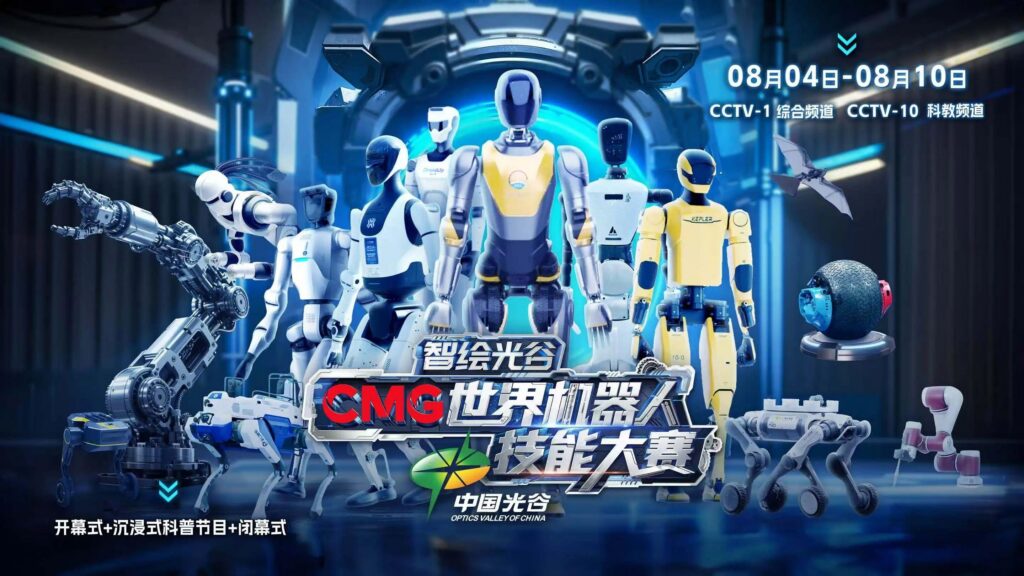
The 2026 CMG competition is currently in active recruitment, inviting teams and operators from around the world. Unitree’s founder Wang Xingxing has publicly announced he will personally compete with his own 1.82-metre H2 humanoid robot. Unitree published a promotional video for the event signaling that a competition date announcement is imminent.
The CMG competition is part of the broader CMG World Robot Competition Series, which also includes robot football and basketball events, designed to spotlight regional robotics industries and promote the integration of science, culture and tourism.
The framing on CMG’s own promotional material is direct: “This is a fighting arena. This is also a testing ground for robots.” China’s state broadcaster is using the same thesis that ProRL, UFB and URKL all articulate independently — sport as development infrastructure — as the official positioning of a nationally televised series.
While the US Congress debates legislation that would ban Chinese humanoid robots from American soil, China’s national broadcaster is running a globally recruiting humanoid robot combat competition. That juxtaposition is not subtle.
The Prize — What Ten Million Yuan Actually Means
The $1.44 million prize pool is worth contextualizing against other robot sport prizes that have existed before URKL.
BattleBots, the most successful robot combat television format in history, paid relatively modest prizes across its Comedy Central run — the show’s value was primarily in broadcast exposure rather than prize money. The DARPA Robotics Challenge 2015 Finals paid $3.5 million across multiple podium positions, but as a one-off government research competition rather than a recurring professional league. URKL’s ten-million-yuan championship prize, paid from a private organizer to a winning team in a professional seasonal league, has no real precedent in robot sport history.
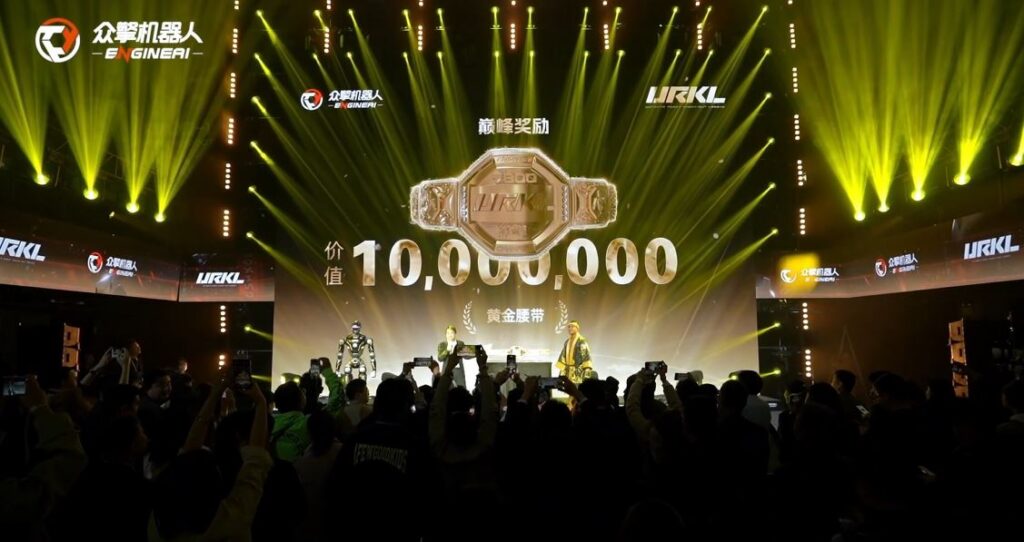
The pure gold belt — ten kilograms of gold — is a deliberate aesthetic statement as much as a financial one. It positions URKL within the visual language of elite professional combat sport. The WBC, WBA, IBF championship belts in boxing are among the most recognized trophies in world sport. URKL’s gold belt says, explicitly, that this is that category of competition — not a science fair, not a demonstration, not an exhibition. A professional championship with a physical trophy that means something.
What Comes Next
The Ultimate Robot Knockout Legend 2026 season follows a tiered competition schedule through December, with the championship final determining which of the sixteen competing teams claims the gold belt and the ten-million-yuan prize.
Beyond the current season, the questions URKL is generating are as significant as the competition itself. If a hybrid of autonomous robot actions along with a human operator produces more spectacular movement than human-piloted combat alone — which the aerial rotation kicks and combination strikes already suggest — does audience preference eventually consolidate around this format?
The answer to that question will shape what professional robot combat sport looks like in ten years. URKL is running the experiment in real time, with sixteen teams, a $1.44 million prize, and a national broadcaster in China already treating the format as mainstream entertainment.
Robot combat sport is no longer asking whether it can exist. It’s asking what form it takes.