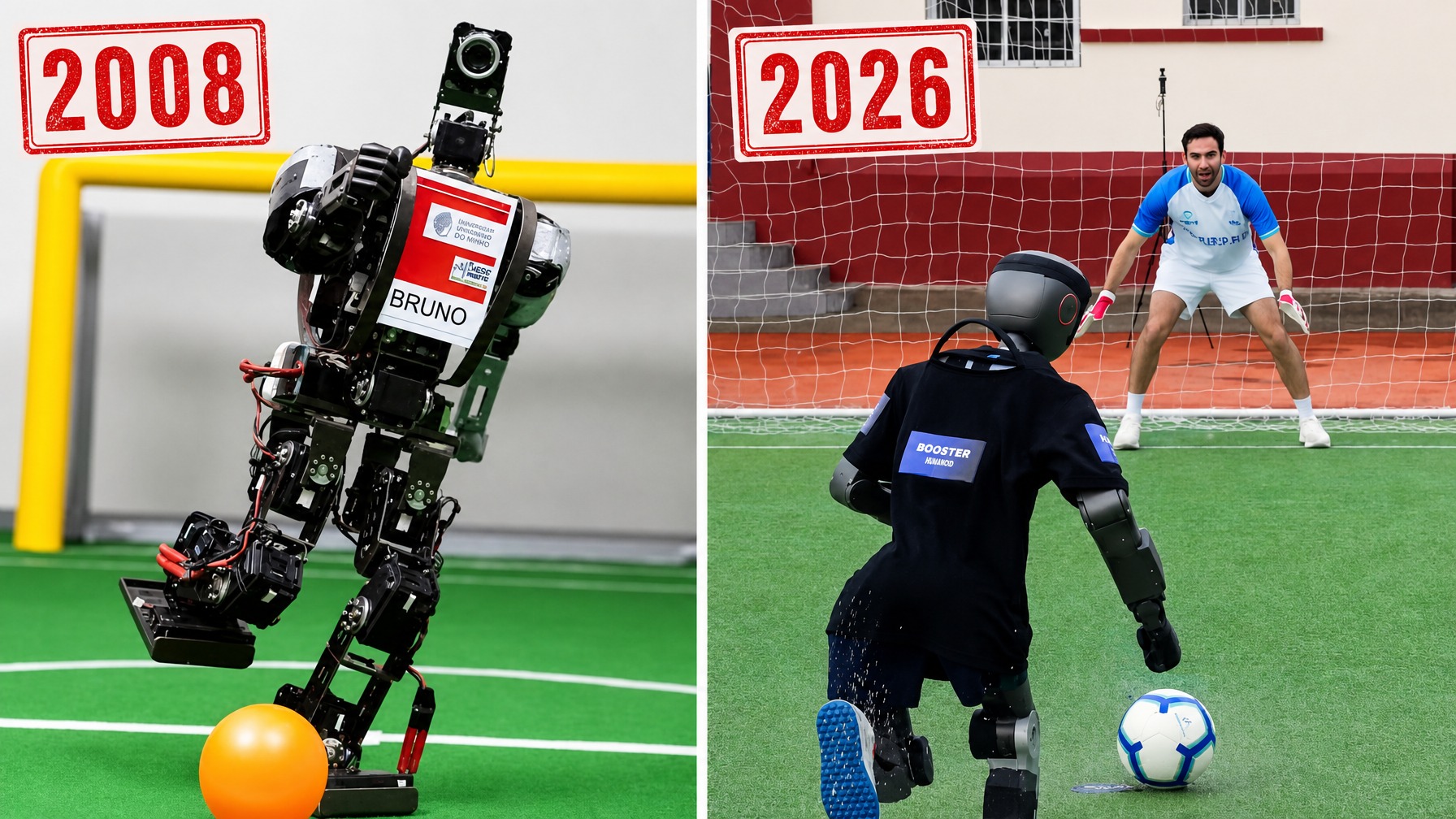
RoboCup 2026 ran June 30–July 6 at Songdo Convensia in Incheon, drawing 59 teams into the humanoid leagues from dozens of countries. When the final whistle blew, 38 of those 59 teams were competing on robots built by Booster Robotics — and they didn’t just show up. They took every podium position, in every division.
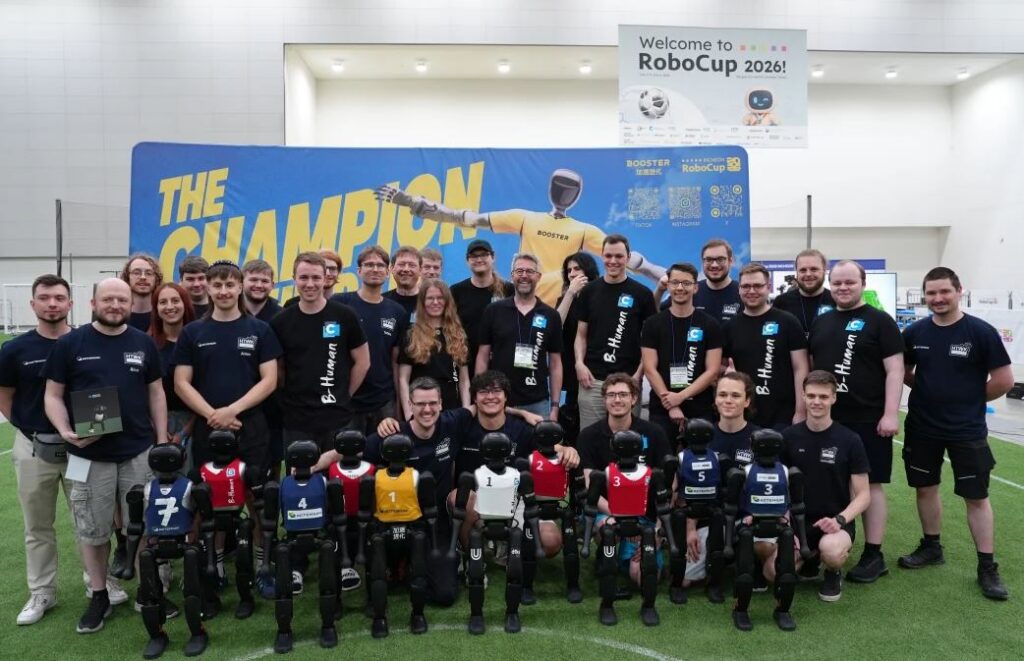
Who Won RoboCup 2026’s Humanoid Soccer Divisions?
The results, division by division:
- Large Division: Champion — Tsinghua Hephaestus. Runner-up — CAU Mountain&Sea. Third — BISTU Water. All three competed on the Booster T1.
- Middle Division: Champion — B-Human. Runner-up — HTWK Robots. Third — Rhoban. All three on the Booster K1.
- Small Division: Champion — Invic. Runner-up — Hamburg Bit-Bots. Third — GeoHBots. Invic and GeoHBots competed on the Booster K1 Air, a lighter variant of the K1 platform.
Three divisions. Nine podium spots. Eight of them Booster hardware — the exception being Hamburg Bit-Bots’ silver in the Small Division.
How Did One Company Sweep Every Podium Position?
It helps to have already been RoboCup’s official hardware partner going into the tournament, supplying discounted robots and development tools to entering teams. But the scale of this result — 38 of 59 humanoid teams choosing Booster’s platforms — points to something flagged before as a structural shift in the sport: teams increasingly buy the body and pour their effort into the software.
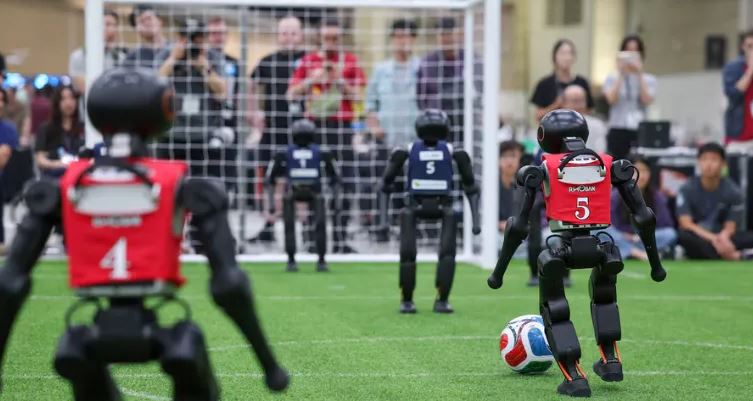
That’s a real change from a few years ago, when most of a team’s budget and engineering hours went into building the robot from scratch — the mechanical design, the actuators, the basic act of staying upright. This year, teams that bought Booster’s hardware off the shelf spent their time instead on perception, split-second decision-making, and getting multiple robots to coordinate as a team. The contest has shifted from who can build the robot to; who can make it smarter.
What Happened in RoboCup’s First Full 11-a-Side Humanoid Match?
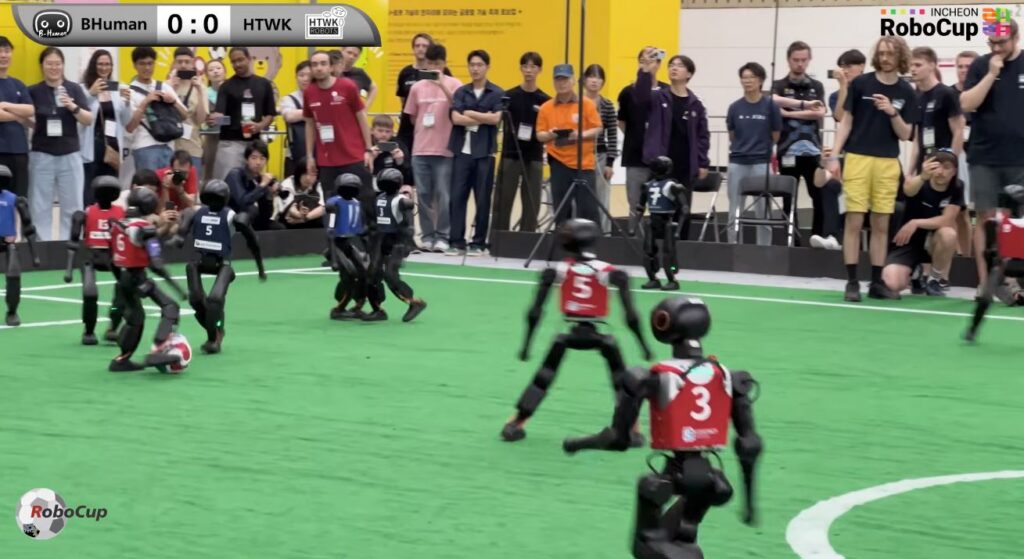
Buried inside the tournament is a milestone worth pulling out on its own: RoboCup 2026 marked the first time two complete teams of humanoid robots played 11-versus-11, on real hardware, under standard rules. B-Human beat fellow German side HTWK Robots 4–0.
Nobody is claiming these are Messi’s replacements. The robots are small, and they wobble. But a decade ago, a single robot walking steadily across a pitch was itself the achievement. Eleven robots a side, playing a full match to a real scoreline, is a different order of accomplishment entirely — and it’s exactly the kind of milestone RoboCup’s founding 2050 goal was built to track.
One competitor put it plainly to Reuters in Incheon: “Our team’s ultimate goal is that we will beat the FIFA champion in 2050.” That’s not new bravado — it’s RoboCup’s founding pledge from 1997, restated by someone actually building toward it.
Why Is Booster Betting on Software, Not Just Hardware?
Alongside the tournament, Booster launched Booster Studio — described as the first integrated development environment built specifically for embodied intelligence, letting engineers program, simulate, and deploy robot behavior before ever touching a physical machine. One of the smallest teams at RoboCup 2026, from Pui Ching Middle School in Macau, trained and validated its algorithms entirely in the simulator before loading them onto real robots.
Booster also launched something separate worth distinguishing clearly: Booster Champion, a Season One simulation tournament (not a physical robot competition) built around the same 3v3 soccer format, aimed at pulling in developers who want to compete on algorithms before ever owning hardware. It’s less a spectator sport and more an on-ramp — Booster’s bet that owning the software layer beneath the sport matters as much as owning the robots playing it.
Does a Clean Sweep Like This Raise Any Concerns?
Worth being honest about one thing: the highlight clips from events like this are heavily curated. Robots that can kick a ball at speed have already caused real, if minor, incidents at other events — RSG has previously covered a Booster T2 penalty kick clocked at 62mph, and wall-denting incidents during earlier testing of the robot model. A robot football pitch, unlike a video game, has real bystanders standing near it. That’s not a reason for alarm. It’s a reason the sport needs the same seriousness applied to safety standards that any human contact sport already has.
How Close Is RoboCup to Its 2050 Goal?
Still a long way, by most honest measures. But the gap is closing faster than the “small, wobbly players” framing suggests on its own. A robot that can hold its position, read the game, and coordinate with ten teammates across a full match is a robot that has solved a genuinely hard set of problems — balance, perception, real-time decision-making — all at once, under pressure, in public.
RoboCup 2026 didn’t settle the question of whether robots will ever beat a human World Cup team. It did show, for the first time, what a full-scale attempt actually looks like.
For more on the lead-up to RoboCup 2026, see our preview coverage of the Incheon tournament. For the fuller story of how humanoid robotics reached this point, see our history of robot athletics.